0775 440 9085 Free 15-min consultation

The Structural Pivot

Joint Tenancy Severance

Converting your property ownership from joint tenants to tenants in common is a critical first step for effective estate planning — unlocking your ability to direct your share of the property through your Will or a Trust.
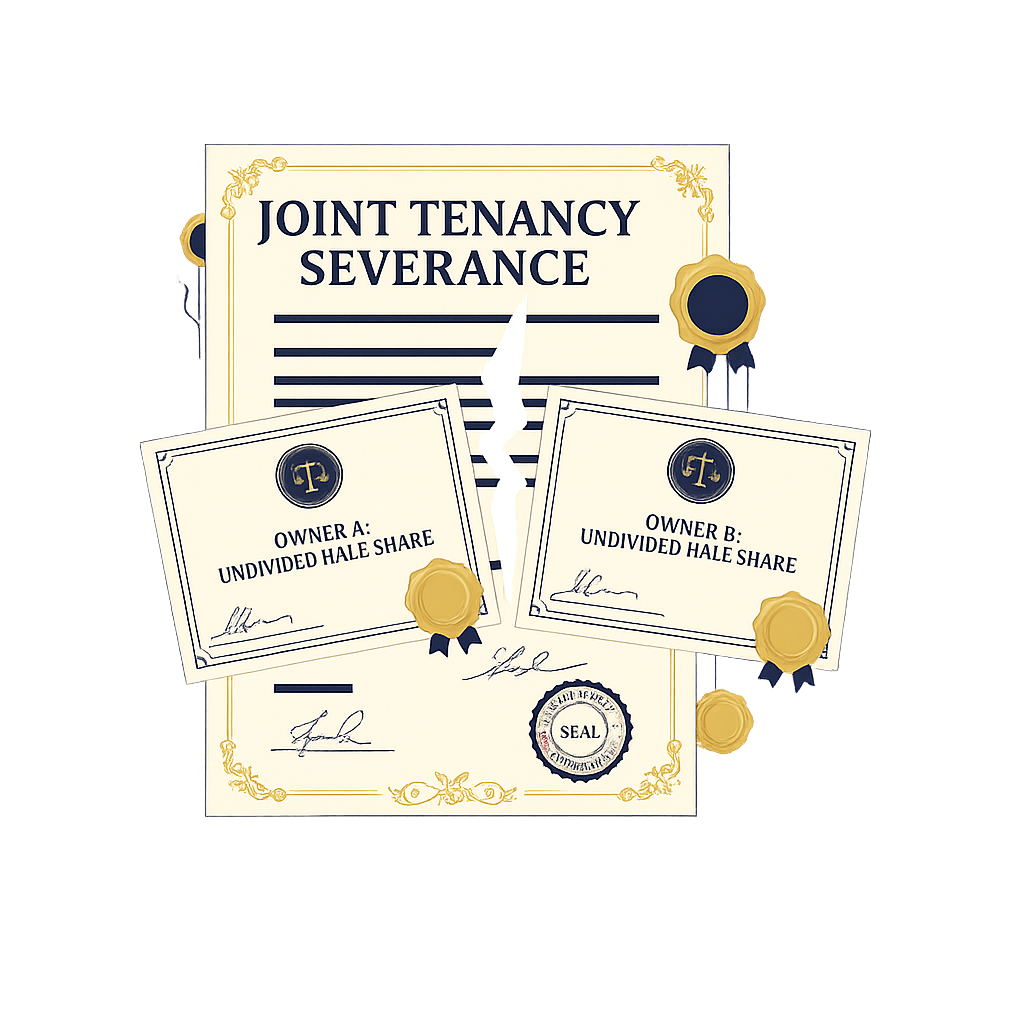
Joint Tenancy Severance

Joint Tenants vs. Tenants in Common

The distinction between these two forms of co-ownership is fundamental to estate planning — yet it is often overlooked until it is too late to change.

Current Default - Joint Tenants

  • The "right of survivorship" applies — on death, your share passes automatically to the surviving co-owner
  • Your Will has no effect on the property — it cannot override survivorship
  • The entire property becomes the survivor's asset for care fee assessment
  • Children from previous relationships may inherit nothing from the property

The Solution - Tenants in Common

  • Each co-owner holds a distinct share (typically 50%) that can be gifted by Will
  • Your share can be placed into a Property Protection Trust for your children
  • Only your share is assessable for care fees during your lifetime
  • Ownership structure aligns with your estate planning intentions

Why Sever the Joint Tenancy

01

Enable Trust-Based Estate Planning

Joint tenants cannot leave their share of property via a Will — it passes automatically to the co-owner. Severing to tenants in common allows you to direct your share through a Property Protection Trust or directly to chosen beneficiaries.

02

Protect Against Care Home Fee Assessments

As joint tenants, the entire property value is assessed for care fees if the survivor enters care. Severing the tenancy ring-fences the first-to-die's share, shielding it from local authority means testing.

03

Safeguard Your Children's Inheritance

If you have children from a previous relationship, severing the joint tenancy ensures your share passes to them — not automatically to a step-parent who may remarry or redirect the asset elsewhere.

04

A Straightforward Legal Process

Severance can be effected by mutual agreement, by written Notice of Severance served on the co-owner, or by a course of dealing. We manage the entire process — from drafting and serving the notice to registering the restriction at HM Land Registry.

How We Execute the Severance

Mutual Agreement

Both co-owners sign a formal Deed of Severance. We draft the deed, arrange execution, and register the restriction at HM Land Registry. This is the most common and cooperative route.

Notice of Severance

One co-owner serves formal written notice on the other under section 36(2) of the Law of Property Act 1925. The notice must be in writing and show a clear, immediate intention to sever. We draft the notice and manage service.

Course of Dealing

Where the conduct of the co-owners demonstrates a mutual intention to sever — such as exchanging correspondence about dividing the property or commencing divorce proceedings. We advise on whether your circumstances suffice.

Our Process

I

Title Review

We examine your Land Registry title to confirm current ownership and any existing restrictions.

II

Advisory Meeting

We explain the implications and ensure severance aligns with your broader estate plan.

III

Severance Execution

We draft and execute the Deed or Notice — whichever method suits your circumstances.

IV

Registration

We lodge Form SEV and Form RX1 at HM Land Registry to register the Form A restriction.

Secure Your Family's Future

Take the first structural step in safeguarding your estate.

Enquire about Severance